Whisper Large V3 Turbo, Explained in Plain English
Whisper Large V3 Turbo is a faster version of OpenAI's Whisper Large V3 speech recognition model, released in October 2024. It keeps Large V3's encoder, the part that listens, and cuts the decoder, the part that writes the text, from 32 layers to 4. The result is several times faster, with accuracy close to Large V3.
What Whisper is
Whisper is OpenAI's family of open-source speech recognition models. OpenAI released it in September 2022 under the MIT license, a permissive license that lets anyone use it, change it and build it into their own software, including commercial apps, as long as the license notice is kept. "Large" in the name marks the biggest models in the family.
Whisper was trained on large amounts of multilingual audio collected from the web. That's the source of both its strengths and its quirks. Because it learned from real-world speech rather than only studio recordings, it's used to ordinary microphones, rooms and speaking styles. It transcribes 99 languages, and it can also translate speech into English.
A short timeline
| Date | Release | What it brought |
|---|---|---|
| September 2022 | Whisper | Open-source speech recognition and translation to English, MIT license |
| November 2023 | Whisper Large V3 | A new version of the largest Whisper model |
| October 2024 | Whisper Large V3 Turbo | Large V3's encoder with a 4-layer decoder, several times faster |
What Turbo changed
Think of Whisper as two parts working one after the other.
- The encoder listens. It takes a stretch of audio and turns it into an internal description of what was said.
- The decoder writes. It reads that description and produces the text one small piece at a time, each piece depending on the ones before it.
The encoder does its work once for each stretch of audio. The decoder runs again for every piece of text it writes, so a heavy decoder slows down every single word. Large V3's decoder has 32 layers. Turbo keeps the full Large V3 encoder and replaces the decoder with one only 4 layers deep.
That's why Turbo is several times faster while its accuracy stays close to Large V3. The part that does the hard listening is kept, and the part that runs over and over got much lighter.
Why the speed matters
Speed isn't only about saving time. On a phone, a faster model is the difference between waiting for a transcript and watching it appear while you talk. Less work per minute of audio also means less strain on the battery during long recordings. A model of this size that runs several times faster is what makes accurate transcription practical on the device itself, with no server involved. Our guide to offline speech to text covers what that means for privacy and the trade-offs that come with it.
Languages
Whisper transcribes 99 languages and can detect which one is being spoken. Expect accuracy to vary between them: because the model learned from web audio, languages that are widely spoken and well represented online tend to come out better than languages with little recorded material.
Language detection has one practical catch. In Hushtext, for example, the language is decided at the start of a recording, so a recording that switches languages halfway needs extra care. Our guide to transcribing multiple languages explains how to handle it.
Strengths
- Real-world audio. Trained on varied web audio, it copes with everyday microphones, rooms and voices.
- Readable output. It writes sentences with punctuation and capital letters, not a raw stream of lowercase words.
- Many languages in one model. One model covers 99 languages, with automatic detection.
- Open and portable. The MIT license lets developers ship it inside their apps, which is how it can run entirely on your phone.
Known weaknesses
No speech model is perfect, and Whisper's mistakes follow recognizable patterns. Once you know them, they're much easier to catch. (If you want to measure mistakes properly, word error rate is the standard yardstick, with some important caveats.)
Hallucinations in silence
Whisper sometimes writes words nobody said, usually during long silences, music or steady background noise. It tends to fill a quiet stretch with a fluent, plausible-sounding sentence. Because these inventions read naturally, they're easy to miss when you skim.
Accents and less common languages
Strong accents, regional dialects and languages with less training audio produce more errors. A strong accent can also make automatic detection pick the wrong language for the whole recording.
Noise and overlapping speech
Background noise, echo and people talking over each other all cost accuracy. When two people speak at once, words from one or both voices get lost.
Names and rare terms
Unusual names, brand names and jargon may be spelled the way they sound. The model has no way of knowing how your colleague spells her surname.
It doesn't know who's speaking
Whisper writes the words, not who said them. Speaker labels come from a separate step called speaker diarization.
How apps work around the weaknesses
A good transcription app doesn't just run the model. It helps you avoid and catch the model's mistakes. Common approaches:
- Skip or trim silence before it reaches the model, so there's less empty audio to fill with invented text.
- Let you set the language instead of relying on detection.
- Take a vocabulary list of names and terms to spell your way.
- Mark uncertain words, so you check the right places instead of rereading everything.
- Let you run the transcription again with a different setting.
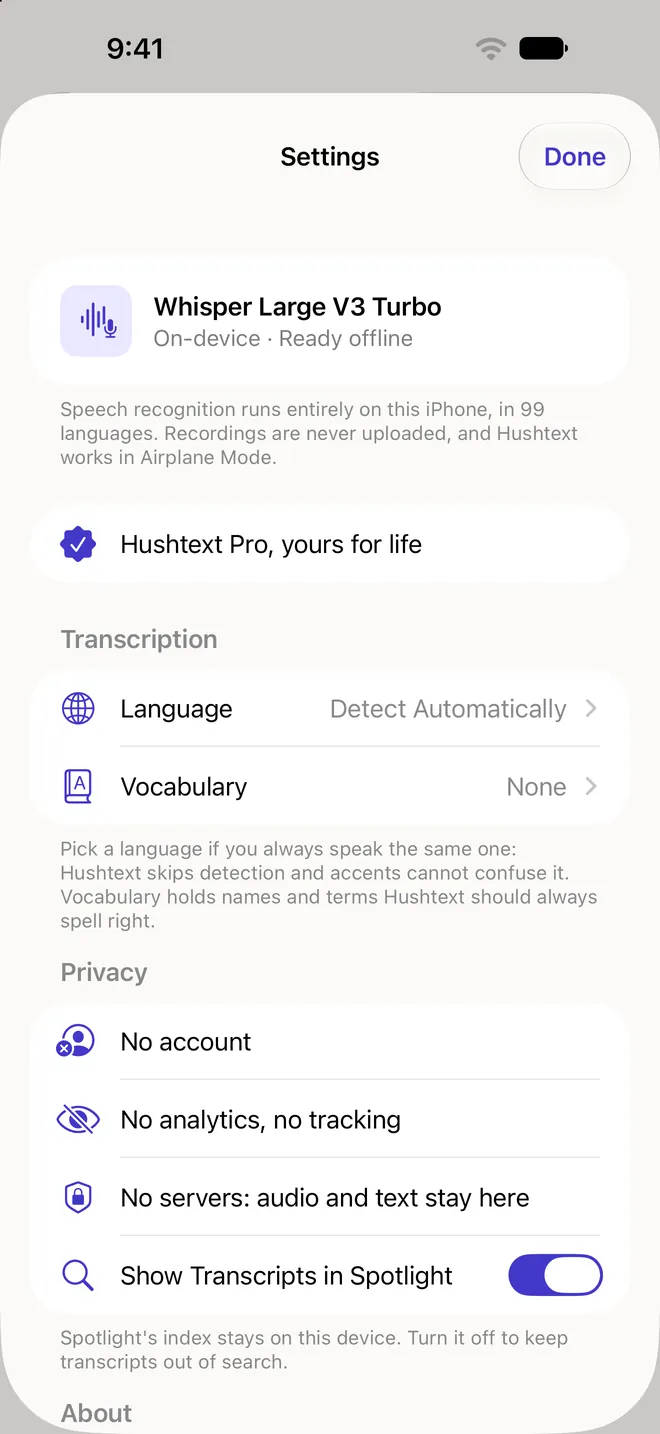
Hushtext runs Whisper Large V3 Turbo inside the app, entirely on your iPhone or iPad, and covers several of these. Words Whisper was unsure of are marked in the transcript. You can set a default language in Settings, or transcribe a recording again in a language you choose. A custom vocabulary keeps names and terms spelled right. During playback, each word is highlighted as it's spoken, and you can tap a word to jump there and hear it, then touch and hold it to fix it.
You can help, too. Pause the recording during long breaks or music, keep the phone close to whoever is speaking, and set the language when you know it. Small habits like these avoid many of the conditions in which Whisper's weaknesses show up.
FAQ
Is Whisper Large V3 Turbo free to use?
The model is open source under the MIT license, so developers can use it and build it into their apps. Each app built on it sets its own terms.
Is Whisper Large V3 Turbo as accurate as Large V3?
Close to it. Turbo keeps Large V3's encoder and uses a much smaller decoder, which makes it several times faster with accuracy close to Large V3.
Does Whisper work offline?
Yes, when the model is installed on your device. Whisper itself doesn't need the internet; whether your audio gets uploaded depends on whether an app runs the model on your phone or on a server.
Can Whisper tell different speakers apart?
No. Whisper turns speech into text but doesn't label who is speaking. Apps add speaker labels with a separate speaker diarization step.